
Be your own ingredients detective
Be your own ingredients detective – because the FDA doesn’t have your back

Be your own ingredients detective – I am amazed at the number of people who trusts that the FDA is looking after them in terms of safety of the ingredients in personal care.
Allow me to tell you the truth: The FDA (Food & Drug Administration) doesn’t have your back. It is not that they don’t want to, but the FDA can’t take action against a chemical unless they have:
“sound scientific data to show that it is harmful under its intended use”, meaning they need evidence showing the harm of the chemical before they put any regulations on it.
So anything goes, from formaldehyde in hair relaxers (that ingredient applied to corpes) to coal tar in your eye shadow. Just to give you some perspective, the EU has banned 1,328 chemicals from being put into their cosmetics, while as of 2020, the US has banned only 30.
The EU begins taking measures to ban a chemicals as soon as there's evidence of its harm. Most of these chemicals are banned already in the EU because they are endocrine disruptors or carcinogens, but still lurk in the conventional personal care sold at your local CVS or supermarket.
Hear me out, is not that there are no safety guidelines for cosmetics, they do exist, it’s just that companies aren’t legally bound to adhere to them. Plus, Congress is partially at fault, because even though they’ve updated the FDA’s ability to regulate other type of products, they haven’t done so for cosmetics since 1938.
The solution may not be to buy only European cosmetics, but if you decide to do so, those picture above are good brands – Benecos, Weleda USA, Puro Bio
You can also do as follows:
1. Familiarize yourself with the main banned ingredients like formaldehyde, coal tar, talc, triclosan, Hydroquinone, red dye #3 & 40
2. Get in the habit of reading label ingredients and identifying the toxic ones
3. Advocate for clean products/ingredients in your personal care
4. Support #greenbeauty products by purchasing those instead of toxic laden conventional ones
5. Realize that your safety and health is your responsibility, so be an informed consumer.
Why wear second-hand clothes
Wearing second-hand clothes can make you an environmentalist

Wearing second-hand clothes can make you an environmentalist!
I must confess that I wasn’t into buying at thrift stores until I moved to NY, where I found amazing and timeless pieces. Truthfully, there was the icky factor and the fact that I had never found anything that I liked or was my style. I never gave it a chance.
I was not aware of the impact that clothes had on the environment, but the more I learned and understood, it was like a veil was removed from my eyes. Buying used clothes — or donating your own — keeps them from going into landfills and conserves the energy needed to manufacture them.
According to thredUP's 2018 Fashion Resale Report, buying second-hand for an entire year saves 13 trillion gallons of water and 165 billion pounds of carbon dioxide. That's equivalent to enough water for the entire state of California for 14 years and enough carbon dioxide to equal all the cars in Los Angeles taken off the road for four years.
Nowadays, some thrift stores are set up with a boutique vibe, so it is easier to look through racks, and spot the really good deals and items. If you are new to thrifting, go with an open mind because you will never know what you will find.
Great finds are vintage t-shirts (bands, cartoons, etc), vintage Levi’s jeans or jeans in general, jackets, leather bags, and designer clothes. But don’t buy just because it is a bargain, you don’t want to invest your money on something that will remain unworn or worst, in the garbage. Don’t give up after your first visit and don’t feel discourage if you didn’t find what you like.
Try a different location, neighborhood, or city that reflects your authentic style. The great thing about thrift stores is that the merchandise is being refreshed constantly, and you will find something you like.
I’m wearing all second hand garments from my favorite stores, Housingworks in NY - and Lotus House Thrift Store in Miami.
How to avoid plastic in personal care
Avoiding microbeads in our personal care help us protect the planet and our health.

Zero Waste Alternatives to microbeads products:
Meow Meow Tweet Body Soap Scub and SW Basics Oats Face Scrub
What are MICROBEADS? These are tiny plastic balls that are less than five millimeters in size and are used in personal care products as exfoliants – for face, body and teeth.
Why was important to banned them? Environmental researchers found that microbeads do not dissolve or wash away but remain intact. They are so tiny that most systems can't filter them out so they travel from your bathroom into rivers, lakes, and oceans. Once there, fish confused them with food, and if you are a fish eater, well, you eat them too. In the US, President Obama signed the Microbeads bill on December 28th, 2015 prohibiting the manufacture and introduction into interstate commerce of rinse-off cosmetics containing microbeads.
These beads are made of polyethylene or high density polyethylene or a combination of both, and as you may know these materials are not biodegrable. A single bottle can contain up to 300,000 microbeads.
How to know if your personal care product has microbeads? The website BEAT THE MICROBEAD has an extensive database that allows you to identify which products contain microbeads by name or brand. There is also an app available for both Iphone and Androids. In addition, they offer a listing of products that do not contain microbeads by categories, ie, face makeup, deodorant, toothpaste, etc.
Now that you know what microbeads are, and which products contain them, you can make an informed decision next time you need a face scrub.
Below is a list of exfoliants/scrubs that are safe for you and the planet. Zero Waste Alternatives mark with *
FACE
Acure Brightening Facial Scrub - Gently exfoliates your skin while french green clay and organic lemon peel remove impurities from your pores.
SW Basics Exfoliant* - USDA Certified Organic oat and almond flours that are not too rough with mineral-rich sea salt, make a simple, nourishing, super-effective exfoliant that leaves your skin soft and glowing.
PAI Skincare Kukui & Jojoba Skin Brightening Exfoliator - Jojoba Beads gently roll over skin, lifting away dead skin cells and surface impurities as they go. Enriched with exotic oils, the nourishing gel formula transforms into a silky milk, washing away to leave skin refreshed and radiant.
BODY
Meow Meow Tweet Tangerine Basil body soap* - Loaded with poppy seeds to massage and stimulate circulation in the skin while exfoliating.
Earth Tu Face Sea Salt + Organic Oils *- Detoxifying Sea Salt stimulates circulation of the lymphatic system, while dead skin cells are scrubbed away and organic oil is absorbed for moisture.
Meant The Wonder Polish - Blended with fine-grain sugar crystals, ground coffee, and deeply hydrating oils of avocado, argan, and monoi to exfoliate, firm and moisturize in one go.
MOUTH
Weleda Salt Toothpaste - Fluoride-free toothpaste with sea salt and gentle mineral cleansers to work with your body to effectively clean teeth.
Bite Toothpaste Bits * - Activated charcoal and sodium bicarbonate gently scrubs your teeth and natural mint keeps your breath fresh.
Uncle Harry’s peppermingt toothpaste * - Ingredients like colloidal silver water, sea salt, ionic minerals encourages remineralization of tooth enamel by neutralizing acids and bacteria.
Recipe: Kale Chips
Some people are over kale but they are missing out on its healing properties and how delicious kale chips are.

Kale is a secret weapon against inflammation and chronic pain. Some people are so over kale, that they are missing out on its healing properties. Its anti-inflammatory compounds destroy viruses and promotes the production of healthy new tissue. And on top of that, Kale is rich in omega-3 fatty acids, chlorophyll, amino acids, vitamins A, C, E, K, B-complex and minerals such as iron, magnesium, copper, and potassium. That is why it became very popular among vegans and vegetarians. Smoothies are not the only way to take advantage of the benefits kale offers, so bake some kale chips and enjoy them while you Netflix binge.


Kale Chips with Vegan Cheese
-----------------------------------------------------
INGREDIENTS
1 bundle curly green or purple kale (the purple variety has a milder flavor)
1-2 Tbsp (15-30 ml) melted coconut oil (olive oil and avocado oil are other options)
Brazil nuts to grate on top as vegan cheese – however all these seasonings are a perfect choice
Himalayan salt
Nutritional Yeast
Curry Powder
Cumin
Chili Powder
Onion Powder
Cayenne Pepper
Or a mixture of a few like Himalayan Salt, Curry Powder, and Nutritional Yeast
PREP
Preheat oven to 300F
Rinse and thoroughly dry kale
Tear the leaves into pieces
Compost the stems or freeze them for future use in smoothies or soups
Add kale leaves into a large mixing bowl
Drizzle the oil and massage well until every leaf is covered.
Sprinkle the seasonings -except the brazil nuts, they taste better after the kale is baked
Spread out the kale onto a baking sheet making sure is not to overcrowded
Bake for 10 minutes and then rotate the pan
Bake for 10-15 minutes more until the kale begins to firm up
The kale will shrunk and the leaves will golden
Approx 25 minutes kale should be ready
Let it cool so it’s crispy enough - while it cools, grate the Brazil Nuts on top. It will resemble parmesan cheese. If you eat cheese, grate parmigiano reggiano or pecorino.
TIPS:
Bake at low temperature to ensure crispiness
Make sure kale is completely dry before baking
Add any liquids like tamari sauce after the kale has cool to avoid sogginess
Layer some rice inside your container to absorb humidity
May last up to 3 days - depending on the seasonings you chose.
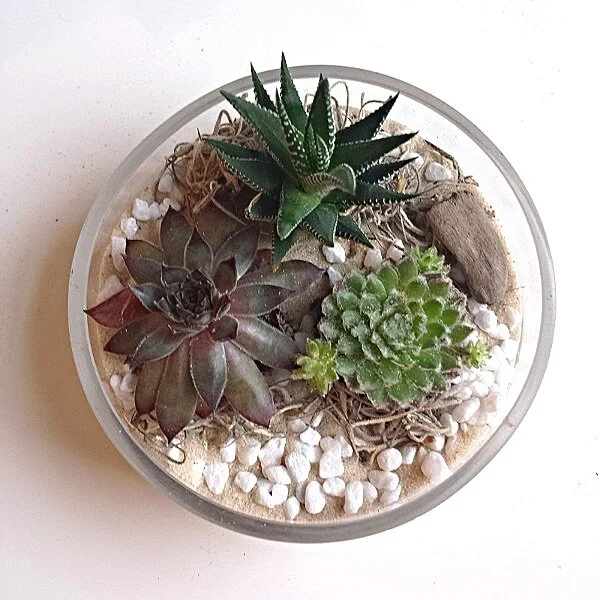
DIY: A Succulents Mini Garden
If you don’t have a green thumb, succulents are the best answer. Here are 10 steps for a small terrarium.

If you don’t have a green thumb, Succulents my friend, are the answer. They thrive by the sun and need little water. Succulents are the friends of frequent travelers. Your neighbor says that he/she will water your plants and she may either forget or eagerly water them too much.
Succulents are the best alternatives for an eco home, in these days of draughts you can water them once a month if necessary. You can even keep them in the bathroom, as the moisture will be enough to keep them alive.
To do your own succulent garden, you need a few things that you can buy at a flower shop, craft store, or home improvement store. One important thing to remember: You can choose a terracotta, glaze ceramic, or glass pot. But if you choose glass you need to be very careful how often and how much you water it. A terra cotta or ceramic pot will provide better air flow and allow the soil to dry out easily. Or choose a container with a hole in it for water drainage.
Here is what you will need:
A variety of Succulents depending on the size of your pot/container
Moss
Rocks, pebbles, gravel, or river rocks
White Sand Soil Cover - like this
A container of your preference
Wood pieces for decoration

Instructions:
1.- Distribute the sand evenly in the container – fill 1/3 of the container.
2.- Place some rocks for drainage as a second layer.
3.- Add more sand – it will cover the rocks
4.- Make holes with your finger where you will be placing the plants
5.- Gently pull each succulent from the container – make sure to not disturb the roots - and place each one in the holes you made
6.- Cover the soil with the rest of the sand – you shouldn’t see the soil
7.- Sprinkle the gravel or place the rocks of your choice around the succulents
8.- Arrange the moss around the succulents – it helps with moisture. Moss comes in a variety of colors to match your decor.
9.- Add wood pieces or any other item you would like for decoration
10.- Lightly water your succulents
Tips:
Always water from the top onto the leaves - using a spray bottle is recommended
It is normal if the lower leaves, near the bottom of the stem, shrivel up and die. Just removed them from your garden.
If your plants develop bugs, you may have watered them too much. Stop watering them and use a combination of water and alcohol and spray them to kill any bugs.
Do not allowed for the A/C vent to hit directly on them.
The first step to a Sustainable Closet
The first step to a sustainable closet is neither buying from ethical designers nor buying second-hand clothes.

What is the first step to a Sustainable Closet?
You may be surprised to know that the answer is neither buying from ethical designers nor buying second-hand. It is actually Wearing and Re-Wearing the clothes that you already have in your closet.
According to Overdressed: The Shockingly High Cost of Cheap Fashion, an American woman adds an average of 64 pieces of new clothing to her wardrobe each year, although back in 1930 she only had 9 outfits altogether. On top of that, the avg. person only wears about 20% of the clothing in his or her closets.
Most clothing goes unworn because it's the result of an impulse buy or it doesn't fit correctly. You know, that piece of clothing you truly liked but that you will wear once you lose the weight or when that ideal day comes.
“Fashion” – is those clothes you wear every single day, and it has a huge impact on human, social, and environmental capital. Assessing what you currently own and re-wearing it should be the first step towards a more conscious wardrobe.
What you don’t use, should be disposed correctly -either donate it, swap it with a friend, or give it a new home. If the clothes are no longer wearable, make sure it goes into a clothing recycling bin.
If you must buy something new, think: Will I wear it a minimum of 30 times?
The idea is to get you thinking of your clothes as an investment rather than something disposable. And that is the behind SLOW FASHION rather than FAST FASHION.
Is Your Mattress Toxic?
Conventional mattresses are made from petrochemicals, synthetic materials and chemical additives. Since we spend one-third of our lives in bed, a better option is a mattress made from natural materials like wool, latex, organic cotton, or bamboo
![[photo credit: Coco Mat USA]](https://images.squarespace-cdn.com/content/v1/557f4891e4b016b020ff2427/1594497761174-9WIEDZ83JMK9BVQVB7KS/MATTRESS%2BCOCO.jpg)
[photo credit: Coco Mat USA]
Most mattresses in the market today are made from petrochemicals, synthetic materials and chemical additives. Yes they are, made out of all those names that are hard to pronounce and that we actually find in pesticides and insecticides like roach killers.
You may think that our bodies can’t tell the difference, but that “new” smell that comes with your mattress is off gassing tons of chemicals into the air that you breathe and those poisonous chemicals like flame retardants can pass through the mattress covers.
It is required by Federal law that all mattresses contain fire-retardant materials (because some people fall asleep while smoking) and the most common way to make mattresses fire-retardant is to douse them in toxic chemicals that can cause lung and heart problems, skin irritations, and other issues.
Below are a few of the toxic chemicals that can be found in conventional memory foam mattresses:
Antimony – Also found in vinyl and PET plastic bottles, is applied inside the fabric of the mattress as fire retardant.
Boric Acid –Also added to interior fabric is bad for the eyes, lungs, and causes irritation.
Vinyl – Used to make mattresses waterproof, contains phthalates and heavy metals.
Polyurethane foam – another plastic used in the internal structure and since it burns easily it requires fire retardants.
Formaldehyde – Commonly used as an industrial fungicide, germicide, and as a preservative in mortuaries serves as an adhesive and causes allergies, asthma, and cancer.
Just like there are organic fruits and vegetables free from harmful chemicals and pesticides, there are mattresses that qualify as organic. Since we spend one-third of our lives in bed, a better option is a mattress manufactured out of natural materials like wool, latex, organic cotton, bamboo, and/or coconut fibers.

![[phot credit: Savvy Rest]](https://images.squarespace-cdn.com/content/v1/557f4891e4b016b020ff2427/1440448546472-18UMTAEHU4OVY1KLGMCT/image-asset.jpeg)
[phot credit: Savvy Rest]
If you are in the market for a new mattress, below is a list of brands of organic mattresses to choose from:
SAVVY REST
Organic mattresses made with layers of natural latex foam rubber, organic cotton, certified organic wool in a wide range of custom combinations.
OMI
Poduces luxury certified organic mattresses and bedding, proudly handcrafted in America from the highest quality sustainable raw materials available.
ROYAL PEDIC
Luxury mattresses made with the finest natural materials from around the world, from pristine long staple cotton, to natural latex sourced from sustainable plantations, to the exuisite comfort of all natural lamb’s wool.
AVOCADO
One of the most popular brands and affordable natural mattresses on the market made with 100% GOTS organic certified cotton & wool, 100% natural latex
COCO MAT
Coconut fiber, provides adequate support for the body’s weight, while the more elastic layers of natural latex follow the body’s shape.
AWARA
Made with a layer of Rainforest Alliance-Certified Dunlop latex coupled with premium coil springs that adjust to your body’s unique curves and 100% Organic Wool fiber from New Zealand.
SAATVA
Handcrafted with the highest quality materials, including antimicrobial organic cotton, CertiPUR-US certified foams, and eco-friendly components and all of mattresses come with a 120-night home trial.
BIRCH
This NYC-based brand is OEKO-TEX and Rainforest Alliance certified and made with organic, natural, hypoallergenic, and anti-microbial materials, including a natural cotton cover, hygroscopic wool and sustainably-tapped latex.
Cleaning Up Your Act
It’s truly shocking the amount of chemicals found in personal care products these days. Learn how to avoid the most common ones.
![[photo credit: Credo Beauty The store for the largest, safest clean beauty assortment ]](https://images.squarespace-cdn.com/content/v1/557f4891e4b016b020ff2427/1594674845027-1MAWUBBFRMH1EX28B7D8/make%2Bup.jpg)
[photo credit: Credo Beauty The store for the largest, safest clean beauty assortment ]
It’s truly shocking the amount of chemicals found in personal care products these days. The average woman uses 12 products a day and the average man uses 6 products.
80% of the chemicals in those formulations have NEVER been tested for safety.
We find refuge in words like Natural, Herbal, Pure, and even Organic, but unless it is certified Organic, all these words do NOT mean anything at all. The FDA does not have a legal definition for the word Natural, so anything goes in shampoos, lotions, toothpaste, etc.
You must become savvier than the industry so you are no longer fooled by their claims. Learn the widely used TOXIC ingredients, so when you spot them on the label, you can start cleaning out your own stash.
In ALL personal products, avoid Parabens: Methylparabens ethylparaben, butylparaben, methylparaben and propylparaben. Used as preservatives, these chemicals disrupt hormonal function. Look for products that say “Paraben Free”.
Shampoo
Sodium lauryl sulfate (SLS) and Sodium laureth sulfate (SLES) are used to create the foaming effect in shampoos but are skin irritants and cannot be metabolized by the liver - Check for SLS free.
Cocamide diethanolamine (DEA) It’s the sneakiest of chemicals because it’s derived from coconut oil and some brands pass it as “Natural”. Also a foaming agent, that when combined with synthetic DEA is a known carcinogen that has been banned in California.
Better Option: John Master's Shampoo

Hand Soaps & Hand Sanitizers
Triclosan is supposed to kill bacteria but it’s so dangerous that the FDA is having it removed from the shelves. It is an endocrine disruptor and helps to create resistance to bacteria. All you need to do is to thoroughly wash your hands with soap and water for at least 20 seconds.
Better Option: Seventh Generation Hand Soap and Clean Well Hand Sanitizer.

Deodorants & Anti-Perspirants
Aluminum’s function is to block the sweat ducts from releasing sweat. Aluminum is potentially harmful to breast tissues and has been associated to breast cancer.
Better Option: Nourish Deodorant

Nail Polish
Dibutyl Phthalate (DBP), Formaldehyde,Toluene, Formaldehyde Resin, and Camphor. Toxic effects caused by these ingredients: Birth defects, carcinogen, skin irritant, allergen, irritant. This is why “3 free” or “5 Free” nail polishes are becoming more popular.
Better Option: Zoya Nail Polish, Vapour Organics

Body Lotions
Petrochemicals like Mineral Oil, Petroleum Jelly, Propylene Gycol are petroleum-based ingredients with the intention to moisturize but they clog the skin and dry it even more. These ingredients are normally use in gasoline, paint, and antifreeze.
Better Option: Hugo Naturals

So to recap: Avoid SLS, SLES, DEA, Triclosan, Aluminum, Mineral Oil – Make a memo in your phone for the next time you are shopping for personal care products. Add to that: Buy only “3 free” or “5 free” Nail Polish. There’s your cheat sheet. Better yet, download the EWG app, they have already vetted thousands of products for you.
The issue with fast fashion is this
The issue with fast fashion is this: You get what you paid for

The issue with fast fashion is this: You buy it, you get a few uses, and it’s done. When it comes to quality, you get what you paid for.
Not to encourage buying disposable clothes, but if you must, when you are done with it, dispose of it correctly and not in the garbage. Take it to a recycling bin, where it can be transformed into something useful like fleece or insulation.
Donating your clothes from fast fashion chains won’t make you a good Samaritan either, because even thrift stores will sort them out as “junk” and will end up in the garbage or end up polluting countries on the other side of the world:
More than 50 tonnes a day are being discarded, and many items are being dumped on wasteland and beaches and then finding their way into the sea.
Between 10% to 20% of donated clothes are actually sold through charity shops, the rest, like in the case of Burberry, gets incinerated.
So many resources wasted! Next time you need a new piece of clothing, especially staples like jeans, coats or jackets, consider going second hand, vintage, or consignment. Pre-loved clothes are just that, pre-loved, still in good condition and sometimes even with the original tags. Or shop your closet, I bet you will find ways to update your LBD with different accessories.
Like Coco Chanel said “Elegance does not necessarily consist in putting on a new dress”.
Wearing second-hand items from the Lotus House Thrift Store boutique / Shoes by Coclico
Steps for a Conscious lifestyle
The general belief is that leading a more conscious life is either difficult or expensive. The truth is, it could be daunting if you don’t know where to start or without the proper research.

The general belief is that leading a more conscious life is either difficult or expensive. The truth is, it could be daunting if you don’t know where to start or without the proper research. You can take small steps and buy vegetables from the dirty dozen list, replace your conventional body lotion for a certified organic one, and commit to recycle all plastic bottles or ban their use all together.
Here are easy steps to follow for your home, your kitchen, your closet and your personal care items. You can pick and choose which one you want to apply to your daily life, but if you want to apply them all, more power to you.
HOME
Recycle
Plastic lasts forever and most likely it ends up in the ocean, like in the Great Pacific Garbage Gyre. Recycle all your plastic bottles and cans, and remember that you can even recycle old batteries, ink cartridges, and wine bottle corks.
Cleaning Products
All conventional cleaning products are full of toxic ingredients that are known hormone disruptors or carcinogenic. The easiest and most affordable method to clean? White vinegar and water. Vinegar contains 5% acetic acid, which has antimicrobial properties. You can use a mixture of water and vinegar as a produce wash, to disinfect and clean the floor, windows, mirrors, glass, counter-tops. If you are not into DIY, you can find safe brands to buy at Grove Collaborative.
Organic Cotton Bed Sheets
Cotton farming uses more pesticides than any other area of agricultural production. In addition, cotton sheets labeled “Wrinkle-Free”, “Easy Care” and “Permanent Press” indicate that the fabric has been treated with formaldehyde resin, one of the most toxic chemical fabric finishes designed NOT to wash out. You can find organic cotton bedsheets from the following brands: Coyuchi , Alterra Pure, Farm to Home, West Elm, American Blossom Linens
FOOD
Dirty Dozen & Clean 15 Fruits and Vegetables
The EWG (Environmental Working Group) has created a practical list to get you started on shopping organic produce and avoid pesticides. Save money by buying organic fruits and vegetables from the Dirty Dozen List (the ones with the most pesticides residue) and stick to conventional fruits and vegetables from the Clean 15 List. A rule of thumb: if you can peel it, eat it.
Meatless Monday
Did you know that 2,500 cows produce the same amount of waste as a city of 411,000 people? And that it requires 660 gallons of water to make 1 hamburger? That is the equivalent of showering daily for 2 entire months. Animal agriculture is eroding the health of the planet and you can help by consuming less meat. Meatless Monday was created to create awareness about this issue plus skipping meat one day a week is good for your health and fantastic for the planet. Click here to get recipes from the Meatless Monday’s website.
Dairy without Hormones
Choose dairy products that are free from the hormone rBGH -a genetically engineered artificial hormone injected into dairy cows to increase milk production. Everything that goes in to the cows goes into your body. Many studies have noted links associated between this hormones and the risk of cancer, especially breast and prostate cancer, and also allergies. Choose brands like Horizon Organics, Organic Valley, or Whole Foods 365. Better yet choose plants based milks from almond, hemp, or coconut.
FASHION
Organic Cotton
As mentioned above, cotton farming is one of the most polluting industries in the world. Build your wardrobe by buying staples like t-shirts, underwear and jeans made of organic cotton or more sustainable fabrics like tencel, modal, and bamboo. These brands make wardrobe essentials from organic cotton: Pact, Yes And, Nudie Jeans.
Ethical Fashion
Be knowledable of where your clothes are coming from, many pieces are manufactured under poor labor conditions in countries like India and China. Check the brand's website to see if they have a transparent supply chain and details where the clothing is made and under which conditions. The Good On You app is a handy resource to use to identfy the best ethical brands.
Vintage and Thrift Stores
By buying second hand you keep old/used clothes from ending in landfills. Check out vintage stores, thrift stores, or E-Bay. You do not need to part from what you currently have in your closet, but if you don’t use it, either donate it or hold a “swap party” with your friends. This is the best way to refresh your wardrobe without spending a dime.
PERSONAL CARE
Skincare and Body-care
Check labels for things like Parabens, SLS, DEA, and Triclosan and avoid them at all costs. The retail store Credo has an extesinve list of ingredients to avoid. If you wish to swap your current products start with the products that you use the most like body lotion and shampoo. And before swapping your products, finish them and dispose of the empty bottles properly.
Get in the habit of making conscious purchases - ask yourself if you really need that extra pair of shoes or a new mascara. The idea is to become more conscious with the things you buy.